Hedge Trimming & Hedge Care Bournemouth & Dorset | 01202 022560

Hedge Trimming & Hedge Care — Bournemouth & Dorset

Hedge Trimming &
Hedge Care Dorset

Professional hedge trimming across Bournemouth, Poole, Dorset and Hampshire. All species, all heights — from domestic privet to large leylandii screens, formal beech hedges to rural shelterbelts. Wildlife law compliant, clean results, site left immaculate.

3,000+
Jobs completed
across Dorset
20+
Years combined
experience
£5M
Public liability
insured
5.0
Google rated
35 reviews
£5M InsuredAll hedge work covered
NPTC QualifiedCertified operators
Wildlife CompliantNesting checks carried out
All SpeciesPrivet to leylandii
5-Star Rated35 Google reviews

Professional Hedge Care Across
Bournemouth, Poole & Dorset

Clearcut Tree Surgery provides professional hedge trimming and hedge care services across Bournemouth, Poole, Dorset and Hampshire. From the small privet hedge in a Bournemouth back garden to the long beech or leylandii boundary screens on rural Dorset properties, we bring the same professional standard to hedge work as we do to tree surgery — proper equipment, clean cuts, site left immaculate, all clippings removed.

Hedge trimming is often treated as a simple job — but get it wrong and a hedge can take years to recover. Cutting leylandii back into brown, dead wood kills the tip and it will not regenerate. Cutting beech too early in the year removes this year's growth without giving it time to set. Cutting any hedge between March and July without checking for nesting birds first is a criminal offence under the Wildlife and Countryside Act 1981.

Our team understands the biology of the hedges we work on. We cut at the right time of year for each species, to the right depth to maintain structure and promote healthy regrowth, using professional hedge cutting machinery that produces clean cuts rather than torn, diseased foliage. All arisings are chipped or removed from site — your hedge and your garden are left exactly as they should look.

We cover hedges of all heights and all lengths across the entire Bournemouth, Poole and Dorset area — including hedges that require elevated access equipment and shelterbelts on rural properties. Call 01202 022560 for a free no-obligation quote.

What we include on every hedge job
Nesting bird check before any workBetween March and August, we carry out a visual nesting check before any hedging work begins. If active nests are found, we delay work until the young have fledged — legally required, never skipped.
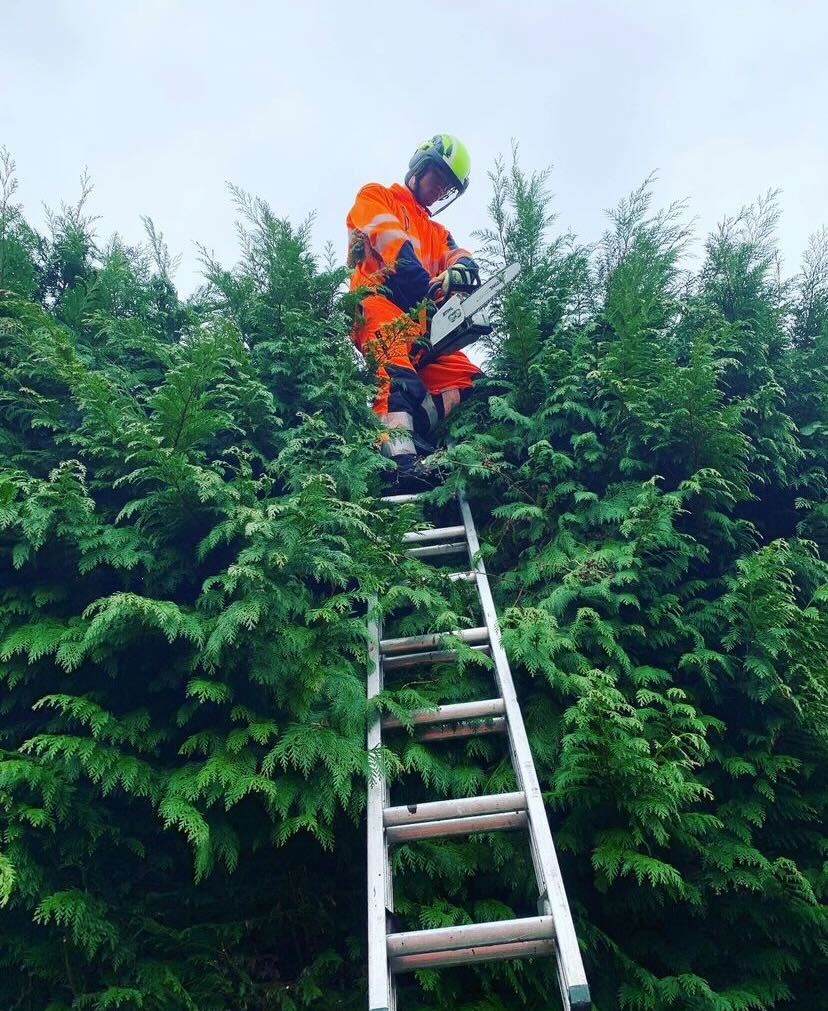
Professional hedge cutting equipmentLong-reach hedgecutters, tracked elevated platforms for tall hedges and professional vacuum collection systems — not domestic equipment producing torn cuts that invite disease.
All clippings removed from siteEvery cutting, every chip — removed from site or chipped on site as agreed. Lawn and borders left completely clean. No clippings left on the surface for you to deal with.
Species-specific adviceWe advise on the best cutting regime for your specific hedge species — how hard to cut, how often, and whether any remedial work is needed to restore shape or density.

Hedge Trimming &
Wildlife Law — What
You Need to Know

The Wildlife and Countryside Act 1981 makes it a criminal offence to intentionally damage, destroy or take from the nest of any wild bird while it is in use or being built. Hedges are one of the most important nesting habitats for garden birds in the UK — and cutting a hedge that contains an active nest during the nesting season is an offence regardless of whether you knew the nest was there.

The nesting season runs broadly from March to July, though some species — including robins, wrens and wood pigeons — may nest earlier or later. The law does not give a blanket ban on hedge trimming during this period, but it requires you to check for active nests before cutting. If an active nest is found — birds sitting, eggs or chicks present — work must stop until the young have fledged and the nest is no longer in use.

At Clearcut Tree Surgery, we carry out a visual nesting check on every hedge job between March and August before any cutting begins. If we find an active nest, we discuss the options with you — delaying the job, cutting only the sections not containing the nest, or leaving the whole hedge until the nest is clear. We never cut through an active nest.

The safest time to trim most hedges is August to February — after the nesting season has ended and before spring growth begins. We advise all our customers to plan their annual hedge maintenance within this window where possible.

August — October: Ideal trimming windowAfter the main nesting season, before winter sets in. Best time for the majority of hedge species — beech, hornbeam, privet, laurel and most formal hedges. Growth has hardened off for the season.
November — February: Still good for most speciesDormant season trimming is safe and effective for most deciduous species. Avoid heavy cutting of beech in very cold periods — frost can damage fresh cut surfaces. Good time for structural work on overgrown hedges.
March: Check carefully before cuttingNesting season begins. Early nesters including robins, blackbirds and collared doves may already be sitting. We carry out a thorough visual check before any March cutting — the job may need to be delayed if nests are active.
April — July: Nesting check essentialPeak nesting season. Many species have multiple broods during this period. We can still carry out work but always check for nests first. Work may need to be deferred or done in sections around active nests.
Late summer trim: some species benefitLeylandii, privet and laurel can be trimmed twice a year — once in late spring (if nest-checked) and again in late summer to maintain a tight, formal appearance through winter.

Different Species —
Different Approach

The most common mistake in hedge trimming is treating all hedges the same. Different species have different growth habits, different cutting tolerances and different ideal cutting times. Here is how we approach the most common hedges across Dorset and Bournemouth.

Very Common

Leylandii

The most frequently requested hedge trimming job across Bournemouth and Dorset. Leylandii grows at up to 90cm per year if untrimmed and can reach 20+ metres. The critical rule: leylandii will not regenerate from brown, dead wood. Any reduction must cut back into green growth — we assess what level of reduction is achievable before quoting. Tall leylandii requires elevated access equipment. We can reduce height, sides and maintain the hedge long-term, but significant reductions need careful planning.

Trim: Late August or early September — once per year sufficient for most
Traditional

Beech & Hornbeam

Beech and hornbeam hedges are among the most beautiful in Dorset — maintaining their russet dead leaves through winter when trimmed at the right time. Both species should be trimmed in late summer (August) once the new growth has hardened off. Cutting too early in spring removes the fresh growth before it has contributed to the hedge's density. Beech and hornbeam both tolerate hard cutting back into old wood — an advantage over leylandii — which means neglected hedges can often be restored with careful management over two or three seasons.

Trim: August is ideal — retains russet winter leaves on beech
Fast Growing

Privet & Laurel

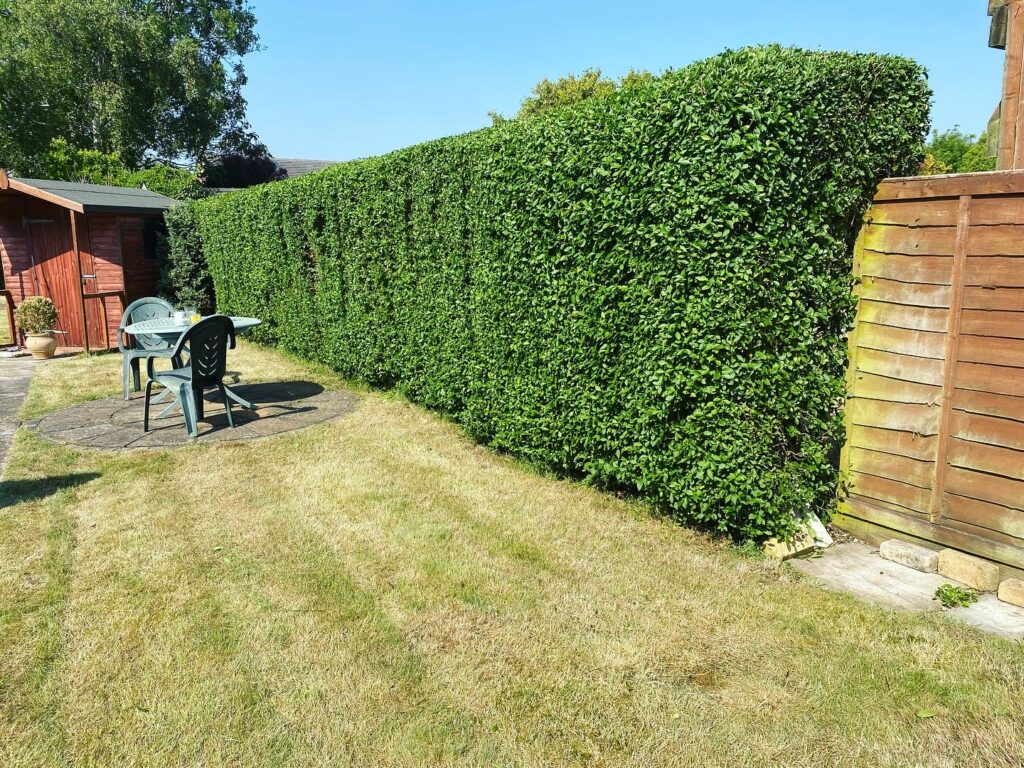
Privet and laurel are the workhorses of Bournemouth's residential gardens — fast growing, tolerant of shade, and capable of producing a dense evergreen screen. Both benefit from two cuts per year in established hedges — once in June (if nest-checked) and again in August or September. Laurel should be trimmed with secateurs or a fine hedge cutter rather than a blade that tears the large leaves — torn laurel leaves turn brown and look unsightly. We use appropriate equipment for laurel to produce clean cuts on every leaf.

Trim: June and August–September for best results
Formal Garden

Box Topiary & Yew

Box and yew are the hedging plants of formal gardens and clipped topiary. Yew is one of the slowest-growing hedge species but produces the finest, densest formal hedge when maintained correctly. Both tolerate very precise cutting — an annual trim in late summer or autumn is sufficient for most formal yew hedges. Box is usually trimmed twice a year to maintain a crisp, formal appearance. We carry out box and yew topiary work with hand shears and precision hedgecutters for the cleanest possible finish.

Trim: August–September for yew; May and August for box
Native

Mixed Native & Hawthorn

Mixed native hedges — hawthorn, blackthorn, hazel, field maple, dog rose and elder — are among the most important wildlife habitats in the Dorset countryside. They require a different approach to formal garden hedges: less frequent cutting, more tolerant of variation in height and width, and always managed to protect their berry-bearing and nesting potential. Native hedges should generally be cut between November and February — outside both the nesting season and the period when berries are most needed by wildlife.

Trim: November–February only — outside nesting and berry season
Rural

Conifer Screens & Shelterbelts

Rural and agricultural properties across Dorset often have large conifer shelterbelts — Scots pine, Corsican pine, Western red cedar or cypress — planted as windbreaks or screening. These are not domestic garden hedges and require commercial hedging machinery and elevated access to manage properly. We maintain shelterbelts of all sizes across Dorset — keeping them at the agreed height and width, removing dead material and ensuring the shelterbelt continues to function as effective screening.

Trim: Late summer — assess for nesting birds before any cutting

Everything Your Hedge
Needs — Done Properly

From annual maintenance trimming to full restoration of overgrown hedges — and complete removal where needed. All species, all heights, all of Bournemouth, Poole and Dorset.

Annual Hedge Trimming

Regular annual or bi-annual trimming for domestic and commercial hedges across Bournemouth, Poole and Dorset. Clean cuts, all arisings removed, site left immaculate. We advise on the right cutting regime for your specific species and garden setting.

Tall Hedge & Leylandii Reduction

Large leylandii hedges and tall screens that require elevated access equipment. We assess achievable reduction levels at the site visit — advising honestly on what the hedge will look like post-cut, and whether full removal may be a better long-term solution.

Overgrown Hedge Restoration

Bringing a neglected hedge back to shape over one or two seasons. Some species tolerate hard cutting back into old wood — beech, hornbeam, yew, hawthorn. Others — leylandii, cypress — do not. We assess what's achievable and give you a realistic plan for restoration.

Formal Topiary & Shaped Hedges

Box, yew and privet topiary and shaped hedges in formal garden settings across Bournemouth and Dorset. Precision cutting with appropriate equipment for the species — hand shears where needed, fine hedgecutters for clean cuts on large-leaved species like laurel.

Hedge Removal

Complete removal of hedges that are beyond restoration or no longer wanted. All roots removed, stumps ground where needed. Site cleared and levelled, ready for fencing, replanting or landscaping. All species including large leylandii and mixed native hedgerows.

Rural Shelterbelt Maintenance

Large-scale shelterbelt maintenance for rural and agricultural properties across Dorset. Commercial hedging machinery for long runs, elevated access for tall screens. Annual or biennial maintenance programmes available with contract pricing for multiple sites.

What Customers Say
About Our Hedge Trimming

5.0

5.0 out of 5 · Based on 35 Google Reviews

Trusted for hedge trimming by customers across Bournemouth, Poole and Dorset

"Large leylandii hedge in our Poole garden — three sides, about 5 metres high. Clearcut reduced it to a manageable 3.5 metres, all sides neat, site completely clear afterwards. Advised us on maintenance to keep it at that height. Excellent."

Alan & Jean P.
Penn Hill, Poole

"Annual beech hedge maintenance on our Wimborne property — long hedge, both sides. Clearcut cut it at exactly the right time in August, perfect shape, all clippings removed and the lane alongside completely swept. They know their hedges."

Frances L.
Wimborne, East Dorset

"Called in June to trim our laurel hedge — Clearcut checked for nests first, found a blackbird nest with eggs and came back six weeks later once the young had fledged. That's exactly how it should be done. Highly professional."

Mark & Susan H.
Southbourne, Bournemouth

Hedge Trimming
Questions
Answered

Question about your hedge? Call 01202 022560 for straight advice — or book a free site visit across Bournemouth and Dorset.

For most species, August to February is the recommended trimming window — outside the main bird nesting season. Beech hedges trimmed in August retain their russet winter leaves beautifully. Leylandii and privet can be done from August onwards. Native hedges are best cut between November and February. We carry out nesting bird checks before any work between March and July.
It depends entirely on the species. Beech, hornbeam, hawthorn and yew all tolerate hard cutting back into old wood and will regenerate — neglected hedges of these species can often be restored. Leylandii, Leyland cypress and most conifers will not regenerate from brown dead wood — any reduction must cut back into living green growth, or the tips will die and the hedge will look permanently damaged. We assess what's achievable at the site visit and advise honestly.
It is not automatically illegal, but you must check for active bird nests first. Cutting through an active nest — one with eggs or chicks — is a criminal offence under the Wildlife and Countryside Act 1981. We carry out a thorough visual nesting check before any work between March and August. If active nests are present, we delay or work around them until the nest is clear.
Yes — but only to the point where green growth exists on the top. Leylandii will not regenerate from brown, dead wood. Before any leylandii reduction, we assess how far back the green growth extends at the top and advise on what final height is achievable. In some cases where the hedge has grown very tall with no green at the top, removal and replanting may be a better long-term solution than reduction.
Costs depend on the hedge's height, length, species and access. A small domestic privet hedge costs considerably less than a long leylandii screen requiring elevated access. We provide free no-obligation site visits and written quotes for all hedge work across Bournemouth, Poole and Dorset. Call 01202 022560.

Hedge Trimming Across
Bournemouth & Dorset

We carry out hedge trimming throughout Bournemouth, Poole, Dorset and Hampshire. Click your area for location-specific information.

Free Quote for
Hedge Trimming
in Dorset

We visit your property anywhere in Bournemouth, Poole or Dorset, assess your hedge, advise on the right cutting approach for your species and provide a clear written quote. No obligation, no hidden costs.

01202 022560

Or WhatsApp us · Email us

Request a Hedge Trimming Quote

Tell us about your hedge and we'll respond within 24 hours.