
Neglected and overgrown trees
An old apple or pear that hasn't been pruned for years is renovated over two or three winters. Taking it all back at once shocks the tree into a mass of water shoots and few fruit.
Every fruit tree has its own season for pruning and its own way of fruiting. We prune apples, pears, plums, cherries and the rest at the right time, the right way, for a healthy tree and a better crop.
Next free quote visits, live from our diary
Clearcut prunes fruit trees across Dorset, Hampshire and south Wiltshire: apples and pears in winter while they are dormant (and trained forms in summer), and plums, cherries and other stone fruit in summer only, to avoid silver leaf and bacterial canker. We take out dead, diseased, damaged and crossing wood, open the centre to light and air, and keep the tree to a size you can pick from, never taking more than the tree can recover from in one year.
Pick a fruit. The calendar shows when we prune it, and why.
Apples are pruned in winter, while the tree is dormant and you can see every branch. Trained apples (cordons, espaliers and fans) are pruned again in late summer to keep their shape.
Pears are pruned like apples, in winter for free-standing trees and in summer for trained forms. They tolerate harder pruning than apples, but grow very upright, so the aim is to keep the branches spreading and the tree to a height you can pick from.
Plums, gages and damsons are never pruned in winter. Cuts made in the cold, wet months let in silver leaf and bacterial canker, which can kill the tree. We prune in spring as growth starts on young trees, and in summer on established ones.
Cherries are stone fruit too, so they are pruned in summer, never in winter. Sweet cherries fruit on older wood and need little more than tidying; acid cherries, such as Morello, fruit on last year's shoots and are pruned after picking to make room for new growth.
Good fruit tree pruning is mostly about light, air and balance, not about how much comes off.
We start with the four Ds: anything dead, diseased, damaged or disordered (crossing and rubbing) comes out first, because that is where disease gets in and branches split.
Then we open the centre of the tree into a goblet or open shape, so light reaches the fruit and air dries the leaves after rain. That means better colour, sweeter fruit and less scab and mildew.
Water shoots, the vigorous upright growth that sprouts after hard pruning, are mostly removed, with a few kept where a new branch is needed.
Finally we bring the height and spread back to something you can manage and pick from, shortening branches to an outward-facing bud or side branch, never leaving stubs.
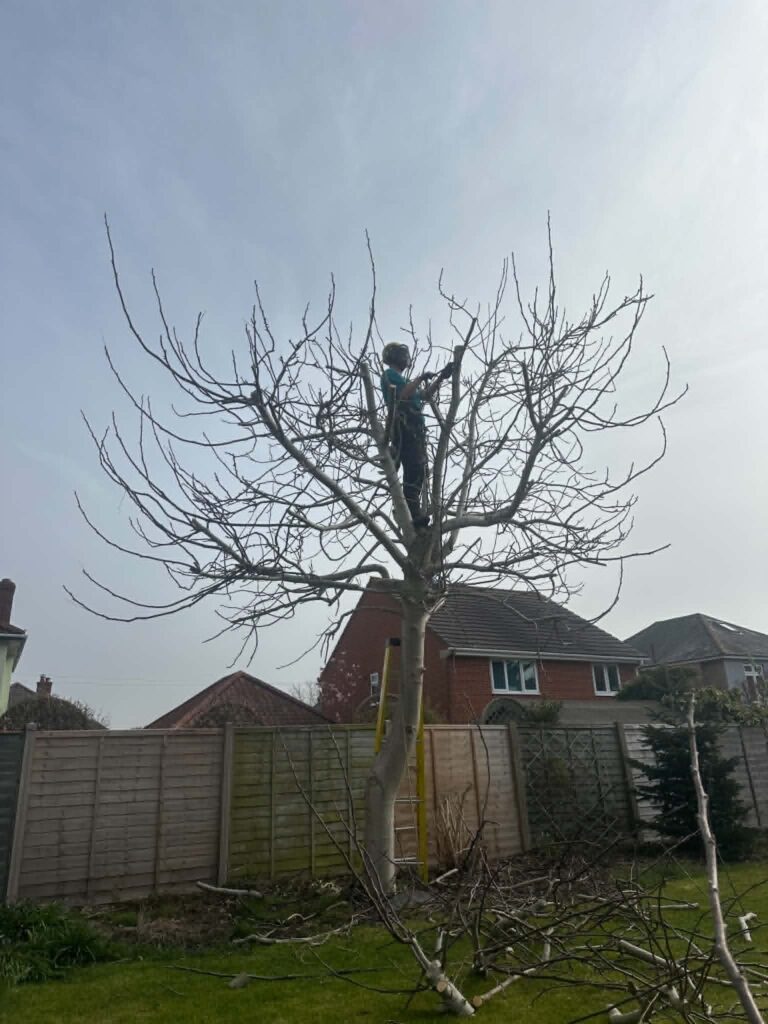
We look at the tree, how it fruits, its health and how big you want it, and tell you when it should be pruned.
A clear price for the work, booked in for the right season for that tree.
Done from the ground with pole saws, from a tripod ladder with hand tools, or from a platform on big trees. No chainsaws on ladders.
Cuttings chipped or taken away for recycling, and the ground left tidy.
What to expect next season, and whether the tree needs a follow-up visit.
An old apple or pear that hasn't been pruned for years is renovated over two or three winters. Taking it all back at once shocks the tree into a mass of water shoots and few fruit.
Cordons, espaliers and fans along walls and fences are pruned in summer to keep their shape and their fruiting spurs, and tied in where needed.
We prune small orchards for schools, community groups, estates and holiday parks, on a yearly visit timed for each type of fruit.
Mistletoe is common on old apple trees in the south. A little is fine, but heavy growth weakens branches, so we keep it in check while pruning.
| Problem | Trees | What we do |
|---|---|---|
| Canker | Apples and pears | Cut out to clean wood, taken away, never left on the ground |
| Scab | Apples and pears | Open the crown for air; clear fallen leaves in autumn |
| Silver leaf | Plums, cherries and other stone fruit | Prune only in summer; cut infected wood well beyond the stain |
| Bacterial canker | Cherries and plums | Summer pruning only; affected branches removed |
| Brown rot | All fruit | Mummified fruit removed while pruning |
| Too tall to pick | All fruit | Height reduced gradually over a few seasons |
Anything not covered here? Ask us and we'll give you a straight answer.
Based in Ferndown, covering all of Dorset, all of Hampshire and parts of Wiltshire.
What customers across Dorset and Hampshire say after the job is done.
Storm damage, fallen trees and dangerous limbs. Fast response across Dorset and Hampshire, 24 hours a day, 365 days a year.
Choose the job, pick a time from our live diary and tell us where. No payment and no obligation.
Want to ask something first? Send us a message and we reply within 24 hours.
Contact usTree down or dangerous? Call 01202 022560, 24 hours a day.
Free No obligation About a minute
What would you like?
Type of work tick all that apply
Pick at least one, so we turn up with the right kit.
Not a booking?
Pick a day, then a time. These come straight from our diary.
We've got your quote visit down and we'll see you then. A member of the team will be in touch if we need anything before the visit.
Preview only: nothing was sent. On the live site this goes into your diary exactly as the bookings page does.
Need to rearrange? Call 01202 022560.
Fallen tree, storm damage or a dangerous limb over a road, roof or power line? Don't book a slot. Call us now and we'll get to you fast, day or night, 365 days a year.
01202 022560 Call nowFill this in and we'll reply within 24 hours.
Thanks. We reply to every enquiry within 24 hours.
Preview only: nothing was sent. On the live site this posts to your diary script and then goes to your thank-you page.
NPTC, City & Guilds and Lantra qualified. £5M insured. Your details are never shared.


